
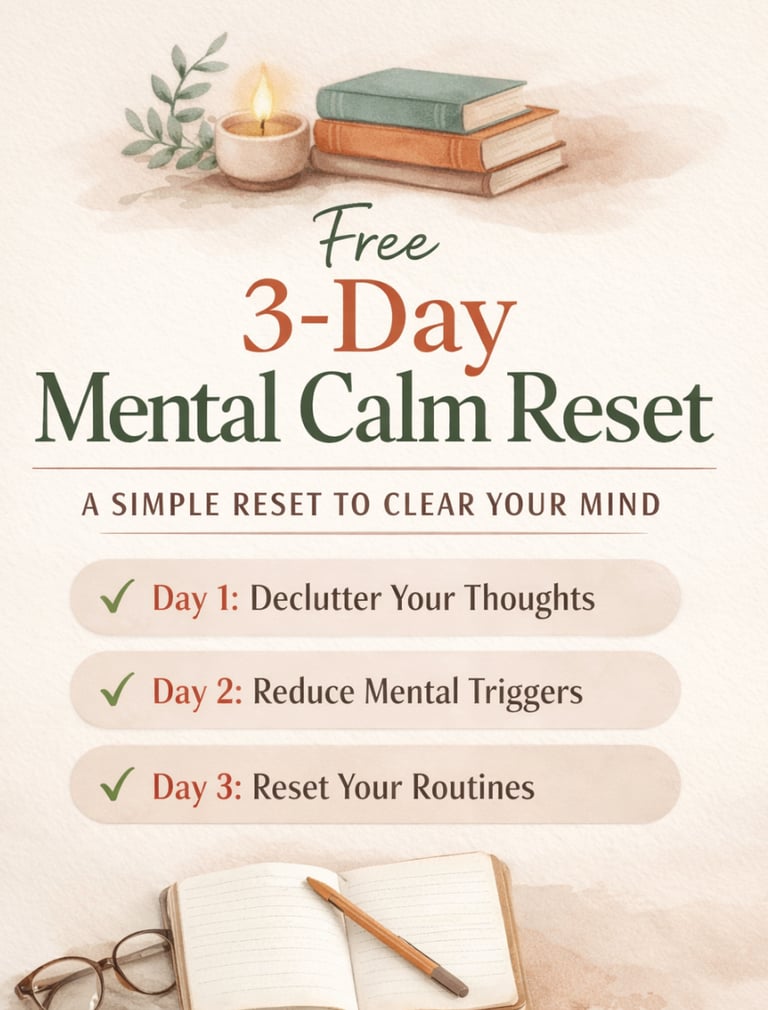
3-Day Mental Calm Reset
Welcome to Your Mental Reboot
You know that feeling when your phone starts glitching—apps freezing, battery draining faster than usual, everything just off? That's exactly what happens to our minds when we've been running on autopilot for too long. This 3-day reset isn't about becoming a different person or achieving zen master status. It's about clearing out the mental clutter that's been piling up and giving yourself permission to hit refresh.
Day 1: Declutter Your Thoughts
Morning: The Brain Dump (15 minutes)
Grab any notebook, open a notes app, or even use the back of junk mail—it doesn't matter. Set a timer for 10 minutes and write down everything swirling around in your head. And I mean everything.
Examples of what this might look like:
"Did I send that email to Marcus?"
"Mom's birthday next week—what am I getting her?"
"Why did I say that weird thing in the meeting yesterday?"
"Need to schedule dentist appointment"
"Am I drinking enough water?"
"That argument from three days ago keeps replaying in my head"
Don't organize it. Don't make it pretty. Just get it OUT of your head and onto paper. Your brain has been trying to be a filing cabinet, a calendar, and a worry machine all at once. Let the page hold it for a while.
After the dump: Circle only the things that actually need action today. You'll probably find that out of 30 thoughts, maybe 4 actually require your attention right now. Everything else is just mental noise.
Afternoon: The "Not Now" List
Create a simple list with three columns:
Do Today (probably 2-3 things max)
Do This Week (the stuff that matters but isn't urgent)
Someday/Maybe (things your brain likes to worry about at 2 AM)
For example, Sarah, a teacher I know, had "reorganize entire garage" bouncing around her head for months. Once she moved it to the "Someday/Maybe" list, she stopped feeling guilty about it every single day. She tackled it during summer break instead, when it actually made sense.
Evening: The Thought Filter Practice (5 minutes before bed)
Tonight, when a worry pops up, ask it these three questions:
Is this true? (Not "might be true"—actually, factually true right now)
Can I do something about it right now?
Will this matter in a year?
Example: "I think my coworker was annoyed with me today."
Is it true? I don't actually know—I'm assuming.
Can I do something now? It's 10 PM, so no.
Will it matter in a year? Almost definitely not.
Let it go for now. If it still bothers you tomorrow, you can address it then.
Day 2: Reduce Mental Triggers
Morning: Identify Your Energy Vampires
Mental triggers aren't just big traumatic things—they're the small annoyances that drain you throughout the day. Spend this morning noticing what makes you feel tense, anxious, or irritated.
Common culprits:
Checking your phone first thing in the morning (hello, work emails in bed)
That one group chat that's always arguing about something
News notifications that make your heart race
The pile of unfolded laundry you walk past 10 times a day
Scrolling through social media and comparing your messy life to everyone's highlight reel
My friend Jake realized his biggest trigger was listening to true crime podcasts during his commute. He loved them, but he'd arrive at work already feeling anxious. He switched to comedy podcasts for two weeks and noticed he started his workday in a completely different headspace.
Afternoon: The 24-Hour Detox
Pick ONE trigger and take a break from it for the rest of today and tomorrow. Just one.
Suggestions:
Put your phone on grayscale mode (makes social media way less appealing)
Mute that stressful group chat
Hide the news app in a folder on the third page of your phone
Clear off that one surface that's been cluttered for weeks
Say no to one obligation that's been draining you
You're not committing to forever. You're just creating breathing room.
Evening: Create a Buffer Zone
This is about building in transition time so you're not bouncing from one thing to the next like a pinball.
Example: Instead of: finish work → immediately start dinner → help with homework → collapse
Try: finish work → 10 minutes of sitting outside with tea → start dinner
That tiny buffer makes everything feel less frantic. One mom I know sits in her car for five minutes after work before going inside. She calls it her "airlock"—the space between work mode and home mode. Game changer.
Day 3: Reset Your Routines
Morning: The Minimal Morning (Even if you only have 20 minutes)
Forget the 5 AM, cold plunge, meditation, journaling, green smoothie routine you saw on Instagram. Let's be realistic.
A real minimal morning might look like:
Wake up 10 minutes earlier than usual
Don't check your phone immediately (just try it)
Drink a glass of water
Do something that feels good: stretch for 3 minutes, sit with coffee in actual silence, look out the window, pet your dog
That's it. You're not trying to reinvent yourself. You're just starting the day as a person instead of a productivity robot.
Example: My colleague Tom started sitting on his back porch for 5 minutes with coffee before his kids woke up. No phone, no plan. He said it was the first time in years he'd heard the birds in his own backyard. Small thing, huge impact.
Afternoon: The Energy Audit
Look at your typical day and identify your personal rhythm.
Ask yourself:
When do I feel most focused? (Protect this time for important work)
When do I hit a slump? (Don't schedule big decisions then)
When do I feel most social? (This is when to take calls or meetings)
When do I need alone time? (Guard this like gold)
For example, if you're sharpest from 9-11 AM, stop scheduling random meetings then. That's your time for work that actually requires brain power. The 3 PM slump? That's fine for answering emails or doing routine tasks.
Evening: The Soft Shutdown
Create a routine that signals to your brain: "We're done for today. You can relax now."
Ideas (pick 2-3 that sound actually doable):
Set a specific "shutdown" time—like 8 PM, the work laptop closes
Change into specific "evening clothes" (even if it's just different sweatpants)
Tidy one small area—kitchen counter, nightstand, whatever
Write down 3 things that went okay today (not even good—just okay)
Do something with your hands that's not on a screen: doodle, knit, cook, play with Lego
Example: A designer I know does a "closing shift" where she spends 10 minutes clearing her desk and making a simple list for tomorrow. She says it keeps work from invading her dreams.
After the 3 Days: What Now?
You're not trying to maintain some perfect new lifestyle. You're just noticing what worked and keeping the tiny bits that actually made you feel better.
Maybe it's the brain dump on Sunday nights. Maybe it's the 5 minutes in the car. Maybe it's just keeping your phone out of the bedroom.
Keep it stupidly simple. The stuff that sticks is never the complicated 17-step routine. It's the small thing you barely notice yourself doing that somehow makes everything else easier.
Final Thought
Your brain has been working overtime trying to manage everything, remember everything, and worry about everything. This reset isn't about adding more to your plate—it's about clearing some space so you can actually see what's on there.
Be gentle with yourself. If you skip a day or only do part of it, that's fine. The goal isn't perfection. It's just a little more breathing room in your own head.
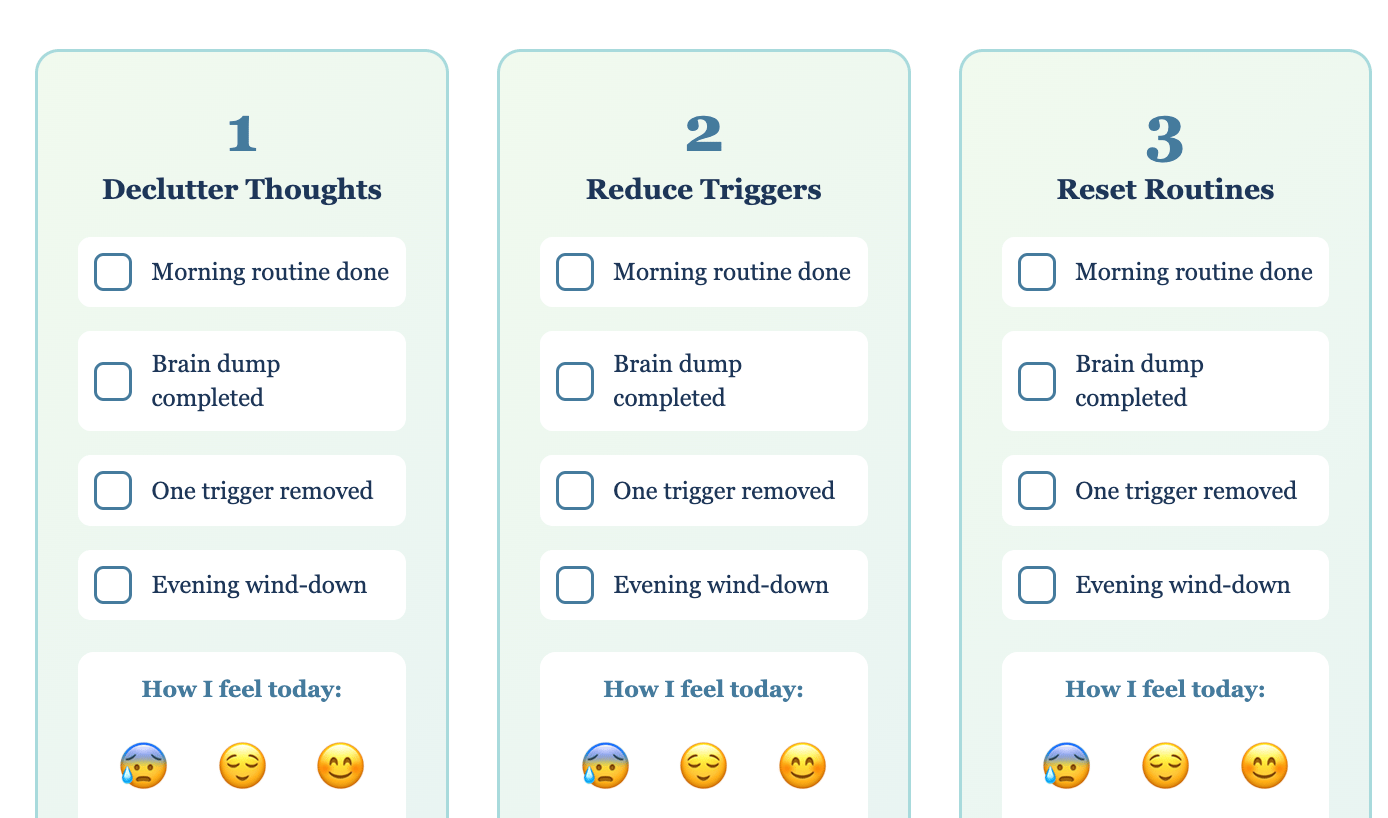
Track Progress with this tracker -
If this resonated with you, I’ve created a gentle 30-day guide to help you quiet your mind and gain clarity.
“30-Day Calm & Clarity Reset for Overthinking Adults”
📖 Get your copy here: https://ak29.gumroad.com/l/xyroiu
Reach US :
Inspire
contact@thewideangle.blog
© 2025. All rights reserved.